
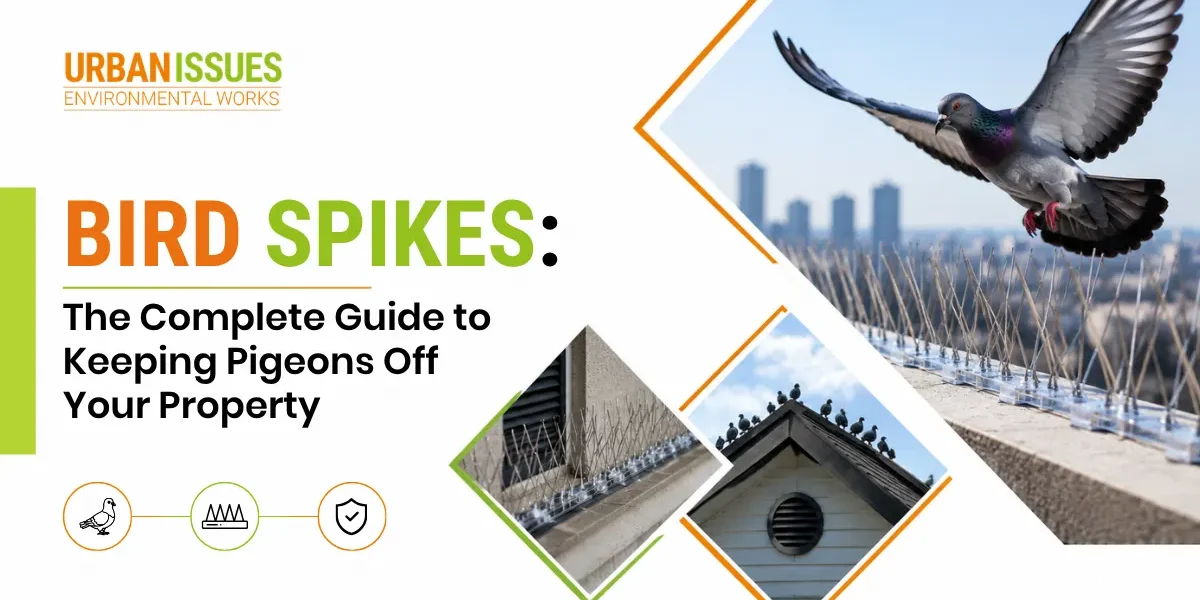
Few urban wildlife issues are as persistent as pigeons.
Property owners regularly deal with blocked gutters, nesting activity, damaged roof structures and large accumulations of bird droppings. A few birds resting on a ledge can quickly become a recurring maintenance problem that can affect both the appearance and condition of a building.
For facilities managers, landlords and homeowners alike, prevention is usually far more effective than dealing with the consequences after birds have established a nesting site.
That’s where bird spikes come in.
Despite their intimidating appearance, bird spikes are one of the most widely used humane bird deterrent systems available today. They prevent birds from landing and roosting without causing them any injuries. It can also help protect your buildings from damage, contamination and ongoing maintenance costs.
This guide will explain how bird spikes work and the different types of bird spikes available. How they should be installed, how they are different from bird netting, and what property owners should consider before installation.
Read More:- Bird Control & Bird Proofing Solutions for UK Properties
What Are Bird Spikes and How Do They Work?
Bird spikes are bird deterrent devices that are designed to prevent birds from landing, roosting or nesting on specific surfaces.
They have a narrow base fitted with upright prongs to create an uneven landing area. Birds quickly learn that the surface is unsuitable for perching and will move elsewhere.
The important point is that bird spikes do not trap, injure or kill birds.
This is one of the biggest misconceptions surrounding bird control systems.
A properly installed spike system simply removes the comfortable landing space that pigeons and other pest birds prefer. The birds are deterred rather than harmed.
Because of this, bird spikes remain one of the most commonly approved bird-proofing methods used across residential, commercial and public-sector properties throughout the UK.
Types of Bird Spikes
Not all bird spikes are the same.
The best solution often depends on the building type, environmental conditions and the species causing the problem.
Plastic Pigeon Spikes
Plastic pigeon spikes are appropriate for residential properties and lower-risk locations.
These spikes are manufactured from UV-resistant polycarbonate or plastic materials. They offer an affordable solution that is lightweight and easy to install.
Some of the advantages of bird spikes include:
- Cost-effective installation
- Lightweight design
- Corrosion resistance
- Suitable for residential ledges and fences
- Available in various colours
Plastic pigeon spikes perform well in many situations. And they are generally less durable than stainless steel alternatives in high-exposure environments.
Stainless Steel Bird Spikes
Stainless steel systems are often considered the industry standard for commercial bird control. The steel rods maintain their shape for years and can withstand harsh weather conditions without deterioration.
Steel bird spikes are commonly installed on:
- Commercial buildings
- Retail units
- Warehouses
- Schools
- Hospitals
- Transport infrastructure
Polycarbonate Bird Spikes
Polycarbonate bird spikes are a more discreet option when it comes to deter birds.
The transparent base easily blends into stonework, decorative facades and heritage buildings where aesthetics are important.
Bird Spike Comparison Table
| Type | Durability | Cost | Appearance | Best Use |
| Plastic pigeon spikes | Moderate | Low | Visible | Residential properties |
| Stainless steel spikes | High | Medium | Visible | Commercial and industrial sites |
| Polycarbonate spikes | High | Medium to High | Discreet | Heritage and listed buildings |
Read More :- Birds Nest Problems in the UK: What Property Owners Should Know
Where to Install Bird Spikes
The effectiveness of bird spikes depends heavily on correct placement.
Installing spikes in the wrong location often leaves birds with alternative roosting opportunities nearby.
Roof Edges and Ledges
Roof parapets, coping stones and ledges are among the most common pigeon resting locations.
These areas provide excellent vantage points and shelter from wind.
Gutter Bird Spikes
Gutter bird spikes are increasingly popular because gutters often become attractive nesting sites.
Whenever pigeons build nests inside gutter systems there are often several issues that can follow:
- Rainwater drainage blockage
- Overflowing gutters
- Water ingression
- Damp problems
- Maintenance costs
Installation of gutter bird spikes can help you prevent nesting activity before these problems even develop.
Windowsills, Signage and Chimneys
Window ledges, shop signs, external lighting fixtures and chimney stacks frequently attract birds looking for elevated resting spots.
Targeted spike installation can prevent birds from repeatedly returning to these locations.
Solar Panel Bird Proofing
Why Solar Panels Attract Pigeons
One of the fastest-growing bird-proofing challenges in the UK involves solar panels.
The gap beneath solar panels creates an ideal sheltered environment for nesting birds. Pigeons are often attracted to spaces that offer protection from weather and predators.
Risks of Birds Nesting Under Solar Panels
Without effective Solar Panel Bird Proofing, property owners may experience:
- Accumulation of nests
- Fire hazards from nesting materials
- Damage to the wiring
- Ventilation problems
- Lower solar panel efficiency
- Increased cleaning costs
- Persistent noise issues
Professional solar panel bird proofing often combines mesh systems with complementary deterrents for long-term protection.
Bird Spikes vs. Netting: Which Is Better?
Property owners often ask whether bird spikes or netting provide the better solution.
The answer depends upon the size and type of area requiring protection.
Bird Spikes vs. Netting Comparison
| Factor | Bird Spikes | Bird Netting |
| Initial Cost | Lower | Higher |
| Appearance | Visible | Less visible from distance |
| Maintenance | Low | Low to Moderate |
| Coverage Area | Small and targeted | Large areas |
| Installation Complexity | Moderate | Higher |
| Best Use | Ledges, signs, gutters | Warehouses, courtyards, loading bays |
When Bird Spikes Are the Better Choice
Bird spikes are typically ideal for:
- Roof edges
- Ledges
- Signage
- Gutters
- Chimneys
- Window sills
When Netting Works Better
Bird Spikes vs. Netting becomes less of a debate when large open spaces are involved.
Bird netting is usually more effective for:
- Warehouses
- Industrial facilities
- Loading bays
- Roof voids
- Courtyards
- Large commercial structures
In many cases, professional bird control programmes combine both systems.
Read More :- Bird Spikes vs. Netting vs. Wire: Choosing the Best AVCL System
DIY vs Professional Installation
At first glance, installing bird spikes can appear straightforward.
On a single-storey residential property, some homeowners choose to undertake installation themselves.
However, there are limitations.
Benefits of DIY Installation
- Lowers the overall upfront cost
- It is suitable for simple applications
- Products are readily available
Risks of DIY Installation
- Leaving gaps that birds can exploit
- Poor adhesion
- Reduced effectiveness
- Premature failure
The biggest concern is safety.
Most of the bird-proofing locations involve working at a certain height. Mostly fragile roofing materials or difficult-to-access structures.
Why Professional Installation is Important
Professional installers can help you with:
- Site surveys
- Risk assessments
- Access planning
- Species identification
- Safe installation procedures
Commercial properties may also require RAMS (Risk Assessment Method Statements), where public access is involved.
Urban Issues Spotlight: The Growing Pigeon Problem in UK Cities
Pigeons have adapted exceptionally well to the urban environments because modern cities provide everything they need.
Why Pigeon Populations Are Rising
There are several factors that contribute to the rising pigeon populations in urban cities:
- Waste food is available in abundance
- Buildings offer warm spaces
- Nesting locations offer shelter
- Limited natural predators
- Dense urban development
London, for instance, offers countless opportunities for pigeons to establish permanent roosting sites.
Health and Structural Risks
Bird droppings are not just an aesthetic problem. Pigeon guano can contribute to:
- Slip hazards
- Corrosion of building materials
- Damage to stonework
- Blocked drainage systems
- Contamination of public spaces
Bird droppings may also contain harmful pathogens and fungal spores that can lead to diseases such as histoplasmosis.
Supporting Cleaner Urban Environments
Proactive bird proofing can reduce contamination before it becomes a larger environmental issue.
When combined with professional guano cleaning, bird control measures can help with creating safer public spaces and cleaner buildings. It can also reduce maintenance costs across urban environments.
This preventative approach aligns closely with the broader goals of creating healthier, better-maintained cities.
Cost of Bird Spikes in the UK
Several factors influence the overall cost of bird spikes.
Typical Material Costs
Average supply costs per metre include:
| Bird Spike Type | Approximate Cost Per Metre |
| Plastic pigeon spikes | £5–£12 |
| Stainless steel spikes | £10–£25 |
| Polycarbonate spikes | £12–£30 |
Installation Cost Factors To Be Considered
- Height of building
- Access requirements
- Quantity of spikes required
- Property type
- Health and safety requirements
- Existing bird infestation levels
A detailed site survey is usually the most accurate way to obtain a quotation.
Bird Spikes and UK Regulations
Bird control must always be in compliance with wildlife legislation in the United Kingdom.
Wildlife & Countryside Act Compliance
Bird deterrent systems should prevent roosting without causing unnecessary harm.
Properly installed bird spikes meet this requirement because they act as exclusion devices rather than trapping mechanisms.
Listed Buildings and Conservation Areas
Additional considerations may apply to:
- Buildings that are listed
- Heritage sites
- Conservation areas
In such cases, bird protection systems such as polycarbonate spikes are preferred to minimise the visual impact.
Why Choose Urban Issues for Bird Proofing?
There is no single product when it comes to effective bird control.
Urban Issues can help you with comprehensive bird-proofing solutions designed around the specific challenges of each property.
Urban Issues can help you with:
- Detailed site surveys
- Risk assessments
- Bird activity assessments
- Humane bird deterrent systems
- Professional installations
- Maintenance recommendations
Alongside bird spikes, Urban Issues can also help you with:
- Bird netting solutions
- Solar panel bird proofing
- Bird wire systems
- Guano removal
- Biohazard cleaning solutions
- Pest control services
This way we help property owners achieve long-term protection by a combination of deterrence, cleaning and preventive solutions.
Need professional bird-proofing advice? Contact Urban Issues today to arrange a site survey and receive a free quotation.
Conclusion
Bird spikes are one of the most effective and practical ways to prevent pigeons from roosting on buildings in London.
They are humane, low maintenance and suitable for a wide variety of locations. They can be installed on residential rooflines, commercial premises and public-sector buildings.
The right solution, however, depends on the structure. The bird species involved and the scale of the problem. Plastic pigeon spikes may be suitable for a domestic property but commercial sites may benefit from stainless steel systems, netting or a combination of bird-proofing measures.
Need expert bird-proofing advice?
Urban Issues can help with professional bird control, bird proofing, guano removal and other cleaning services across London.
Contact our team today to arrange a site survey or request a free quotation.
Frequently Asked Questions
Do bird spikes harm birds?
No. Properly installed bird spikes are designed to prevent birds from landing and roosting. They do not trap or injure birds.
How long do plastic pigeon spikes last?
Plastic pigeon spikes of high quality can last between 5 to 10 years. But the overall durability depends on weather exposure and product quality.
Can I install bird spikes myself?
Yes, small residential installations may be suitable for DIY. But larger or commercial installations should be carried out by trained professionals.
Are bird spikes effective against all birds?
Bird spikes are highly effective against pigeons and many other common pest birds. However, larger bird species may require alternative deterrent methods.
Do bird spikes work on solar panels?
Although mesh barriers are a primary solution for solar installation, bird spikes can be used as part of a broader solar panel bird proofing strategy.