
Most pigeon problems don’t begin with birds. They begin with a maintenance issue.
A blocked gutter. Droppings appearing around a building entrance. Complaints from staff about noise above a suspended ceiling. Sometimes it’s a solar panel system that suddenly requires inspection because nesting materials have accumulated underneath. By the time those signs appear, the birds have often been there for weeks.
Understanding pigeon nesting season isn’t just useful for bird control contractors. It’s valuable for facilities managers, housing associations, commercial landlords and property maintenance teams trying to stay ahead of expensive problems. Pigeons are among the most successful urban birds in the UK, and unlike many species, they don’t limit their breeding activity to a short spring window. That’s one reason a small nesting issue can quickly turn into a much larger maintenance challenge.

When Do Pigeons Nest in the UK?
If you ask someone when birds nest, they’ll probably say spring. They’re not entirely wrong.
The complication is that pigeons don’t always follow the same rules as other birds.
Peak Nesting Season (March–July)
The busiest period of the pigeon nesting season generally falls between March and July.
During these months, longer daylight hours and improved food availability encourage breeding activity. Across London, this is often when property managers first notice increased bird activity around rooftops, service yards and plant areas.
Commercial buildings can be particularly attractive. Flat roofs provide shelter. External ledges offer safe roosting locations. Heating systems can create warm nesting spots even during cooler weather.
By late spring, many urban pigeon colonies are operating at full capacity.

Why Pigeons Can Nest Year-Round in the UK
One of the most common questions property owners ask is: when do pigeons nest?
The simple answer is that they can nest at almost any time of year.
Unlike many native species, pigeons are highly adapted to urban life. Modern cities provide a reliable food supply, relatively mild winter conditions and countless sheltered locations for nesting.
This means the traditional pigeon breeding season doesn’t always tell the full story. It’s not unusual for bird control specialists to encounter active nests during autumn or even winter, particularly on large commercial sites where warmth and shelter remain available throughout the year.
How Long Does a Pigeon Nesting Cycle Last?
Pigeons breed efficiently.
That’s one of the reasons populations can increase so quickly once a site becomes established.
Incubation Period (18–19 Days)
After eggs are laid, both adult birds share incubation duties.
The eggs typically hatch after around 18 to 19 days.
From a property management perspective, this stage often goes unnoticed. Nests are usually tucked away in roof voids, behind plant equipment, under solar panels or in sheltered architectural features.
The birds may be present every day, but unless somebody is specifically looking for them, they’re easy to miss.
From Hatching to Fledging (4–5 Weeks)
Once chicks hatch, things move quickly.
Within four to five weeks, young birds are generally ready to leave the nest.
For those wondering how long do pigeons nest for, a complete nesting cycle often lasts around six to eight weeks from egg laying to fledging.
The challenge is that adult pigeons rarely stop there.
In many cases, a pair will begin preparing for another brood while the previous generation is still nearby. That’s one reason pigeon activity can appear almost continuous on some properties.
How Many Times a Year Do Pigeons Nest?
This is where pigeon management becomes particularly important.
Many property owners assume that if a nest is removed or abandoned, the problem disappears.
In reality, pigeons are persistent.
Multiple Broods Per Year (2–6 Broods)
A breeding pair can produce between two and six broods each year.
Sometimes more.
Urban environments give pigeons advantages that their rural counterparts don’t always enjoy. Food is abundant. Nesting sites are protected. Predators are relatively limited.
As a result, breeding can continue for much of the year.
How Quickly an Untreated Site Escalates
One nesting pair may not seem like a major concern.
The issue is what happens next.
Pigeons have a strong tendency to return to successful nesting sites. Over time, additional birds are attracted to the same location. Nesting materials accumulate. Droppings build up. Maintenance requirements increase.
It’s a pattern bird control professionals see repeatedly.
What begins as a minor issue around a roof access hatch can eventually become one of the site’s most persistent maintenance problems.
This is often where birds’ nest problems become far more expensive than expected.
Heavy nesting activity frequently leads to blocked drainage systems, contaminated walkways and significant accumulations of guano. In these situations, property managers often require specialist cleaning pigeon droppings and professional guano removal before any proofing work can begin.
Pigeon Mating Season vs Nesting Season
The terms are often used interchangeably.
Strictly speaking, they’re not the same thing.
What’s the Difference Between Mating and Nesting Season?
The pigeon mating season refers to breeding behaviour.
You’ll often see this in the form of courtship displays, pair bonding and territorial activity.
The nesting season is broader.
It includes nest building, egg laying, incubation and raising young birds.
In practice, the two periods overlap significantly, particularly during spring and early summer.
Does Nesting Season Affect What Action You Can Take?
Yes. But not always in the way people expect.
One of the most common misconceptions is that no bird control work can be carried out once nesting season begins. The reality is more nuanced.
Active nests containing eggs or dependent young birds may receive legal protection under wildlife legislation. However, the appropriate response depends on the species involved, whether the nest is active, site-specific health and safety risks and the type of work being proposed.
This is why professional site assessments are important. What may be appropriate on one property may not be appropriate on another.
What This Means for Your Commercial Property
The biggest mistake many organisations make is waiting until the problem becomes obvious.
By that stage, pigeons have often been established for months.
Why Timing Matters for Proofing Work
The most successful bird management projects are usually preventative rather than reactive.
Once a nesting site becomes established, birds become significantly harder to discourage.
This is where pigeon proofing measures can make a substantial difference.
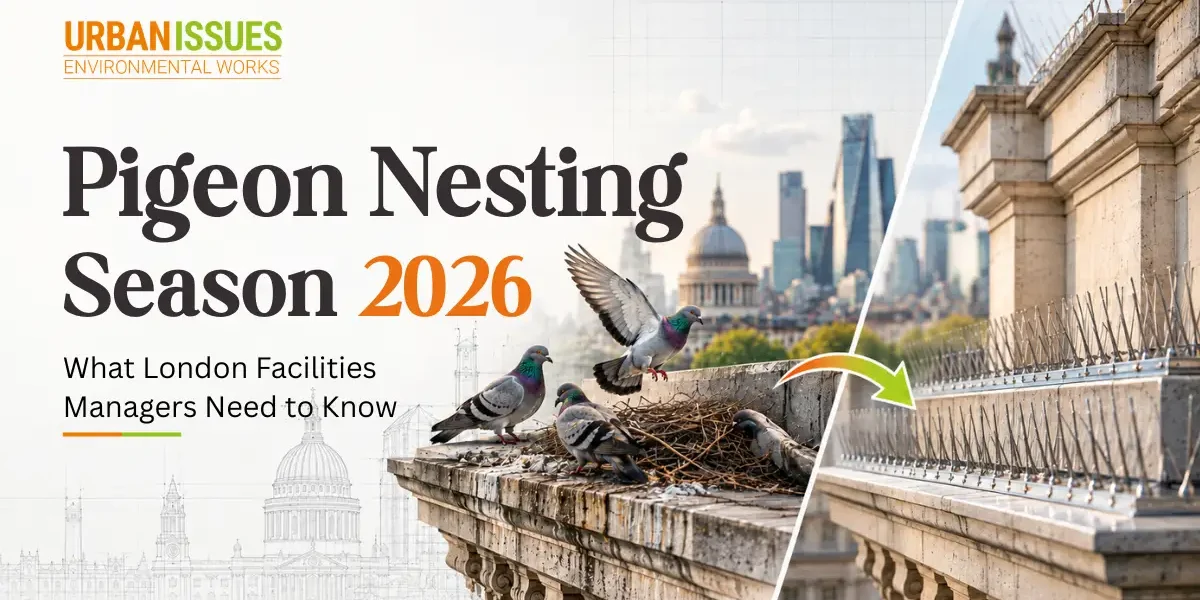
Bird spikes, bird netting, exclusion systems and solar panel protection are generally most effective when installed before large colonies become established.
The Cost of Waiting Until the Problem Grows
A facility manager recently described pigeon activity on a commercial site as “something we kept putting off because it didn’t seem urgent.”
A year later, cleaning contractors were removing substantial accumulations of guano from roof areas while proofing specialists installed exclusion systems across multiple sections of the building.
That pattern isn’t unusual.
The financial impact rarely comes from the birds themselves.
It comes from the secondary problems:
- Additional cleaning
- Drainage blockages
- Corrosion
- Slip hazards
- Damage to equipment
- Increased maintenance visits
Effective Bird Control is ultimately about preventing those costs from developing.
Many organisations now include proactive bird control strategies within planned maintenance programmes because addressing problems early is usually far less disruptive than responding later.
For larger sites, combining Bird Control, monitoring and Pigeon Proofing often delivers the best long-term outcome.
Don’t Wait for a Nesting Problem to Become a Property Problem
The challenge with pigeons is rarely a single nest.
It’s the fact that successful nesting sites tend to attract more birds, more activity and more maintenance costs over time.
Understanding Pigeon Nesting Season, recognising early warning signs and implementing preventative measures before populations grow can significantly reduce long-term property management issues.
If you’ve noticed nesting activity, recurring droppings, blocked gutters or signs of bird occupation around your building, now is often the best time to act.
Urban Issues provides professional bird surveys, Bird Control, Pigeon Proofing, guano removal and tailored bird management solutions across London and the UK.
Contact our team today for a free site assessment and expert advice.
Frequently Asked Questions
Can I remove a pigeon nest myself?
When is pigeon nesting season in the UK?
The busiest period of the pigeon nesting season is generally between March and July. However, urban pigeons can breed throughout much of the year when food and shelter remain available.
Can I remove a pigeon nest myself?
That depends on whether the nest is active. Nests containing eggs or dependent young birds may be legally protected. Professional advice should always be sought before taking action.
How do I stop pigeons nesting in my building?
Long-term prevention typically involves professional Bird Control measures such as bird spikes, bird netting, exclusion systems, solar panel protection and tailored Pigeon Proofing solutions.