
Is your commercial property battling a relentless pigeon problem?
Maintaining the aesthetics and hygiene of a commercial site is a top priority for Facility Managers (FMs). However, bird infestation primarily by feral pigeons and gulls can lead to costly guano cleanup, structural damage, and significant health risks, putting pressure on your maintenance budget.
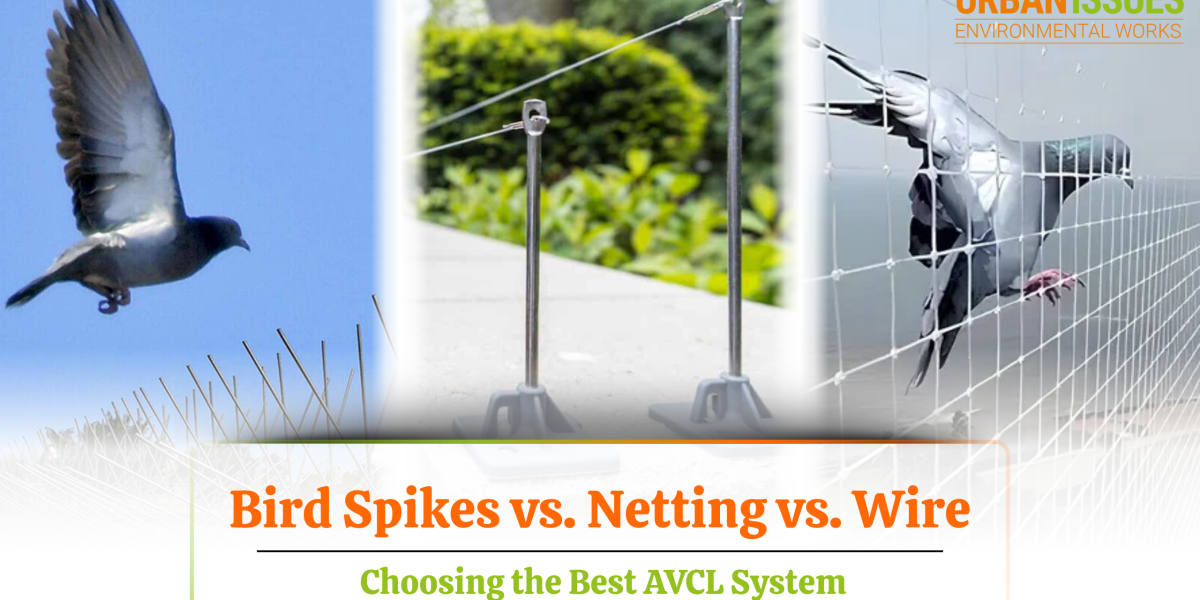
The three primary, humane physical exclusion systems, often called AVCL (Anti-Vermin Bird Control) systems , to solve this problem: netting, spikes, and wire.
This guide provides an objective, head-to-head comparison of these systems, enabling you to select the most effective, durable, and discreet solution, ensuring compliance and long-term protection.
The Three Exclusion Systems: A Technical Breakdown
Choosing the right deterrent begins with understanding how each system is engineered and surfaces are designed to protect.
A. Bird Netting (The Physical Barrier)
Netting is the most comprehensive physical exclusion method available.
- Composition: Heavy-duty, UV-stabilised polyethylene or polypropylene mesh, secured using a perimeter wire frame (often stainless steel).
- Mechanism: Creates a complete, impenetrable barrier, physically blocking birds from entering an entire area. Its effectiveness is 100% when installed correctly with appropriate tension and fixings.
- Best Application: Large, open spaces such as roof plant areas, loading bay eaves, warehouse openings, courtyards, and under canopies where total exclusion is necessary and visual aesthetics are secondary.
B. Bird Spikes (The Landing Deterrent)
Bird spikes are the most common and versatile solution for linear surfaces.
- Composition: Stainless steel wires (preferred for longevity) or poly-carbonate pins fixed to a UV-stabilized plastic or steel base strip.
- Mechanism: They work as a discomfort deterrent by removing the flat landing space, making it physically impossible for birds to comfortably perch or roost on a given surface. They are designed to not harm the birds.
- Best Application: Narrow, linear features such as ledges, parapet walls, window sills, gutters, and signage tops in areas with heavy bird pressure.
C. Bird Wire/Post & Wire Systems (The Discreet Deterrent)
The Post & Wire system is the preferred choice for aesthetically sensitive properties.
- Composition: Thin, high-tensile stainless steel wire suspended by low-profile posts and springs, running parallel to the edge of the ledge.
- Mechanism: The spring tension creates an unstable landing area. When a bird attempts to land, the wire moves and shifts beneath their feet, forcing them to find a more stable roosting spot elsewhere.
- Best Application: Long, shallow, and highly visible ledges, particularly on historical buildings or luxury retail facades where visual impact must be minimal.
Head-to-Head Comparison: Aesthetics, Durability, and Maintenance
This table breaks down the crucial factors that drive your final selection and determine the long-term cost of ownership.
| Feature | Bird Netting | Bird Spikes (Stainless Steel) | Post & Wire System |
| Aesthetics / Visibility | Highly Visible (Can be distracting) | Moderately Visible (Industry standard) | Highly Discreet (Virtually invisible from ground level) |
| Effectiveness (Exclusion) | 100% Effective (Total barrier) | High (Prevents landing on protected line) | Moderate-to-High (Less effective on very wide ledges) |
| Ideal Bird Pressure | Heavy Pressure (Nesting, roosting overnight) | Heavy-to-Moderate Pressure | Light-to-Moderate Pressure |
| Durability & Lifespan | Very High (10+ years, if tensioned correctly) | Highest (10–15 years, weather and UV resistant) | High (10–15 years, discreet and durable) |
| Maintenance | Requires periodic checks for tears, tension, and debris. | Very Low; requires only cleaning of occasional nest debris. | Low; requires checks on wire tension and spring integrity. |
Selection Guide: Matching the System to the UK Building Type
The correct choice depends on where your building sits on the spectrum of Functionality versus Form.
1. Commercial & Industrial Sites (Warehouses, Distribution, Eaves)
- Key Requirement: Maximum exclusion, minimum cost per square metre.
- Recommendation: Bird Netting is the most cost-effective solution for encapsulating large, functional areas where the primary concern is preventing birds from nesting near machinery or fouling stock.
2. High-Visibility Retail & Office Buildings (City Centres, High Streets)
- Key Requirement: Maximum discretion and aesthetic preservation.
- Recommendation: Post & Wire or Stainless Steel Spikes. Use the highly discreet Post & Wire system on main, ground-level facades, reserving spikes for higher, less visible ledges where heavy roosting occurs.
3. Historic & Heritage Buildings (UK Conservation Areas)
- Key Requirement: Minimal intervention and compliance with conservation standards.
- Recommendation: Post & Wire System. This is typically the least invasive option, requiring minimal structural fixing. Its near-invisibility often makes it the only system approved for UK listed buildings and conservation areas.
4. Apartment Blocks & Residential Areas (Balconies, Solar Panels)
- Key Requirement: Comprehensive exclusion to prevent nesting and noise.
- Recommendation: Netting (for balconies/voids) and Specialist Solar Panel Skirting/Mesh. Exclusion is vital to prevent birds from fouling communal areas or damaging solar panel wiring.
Conclusion
Choosing the right AVCL system is a crucial investment in the health, aesthetics, and longevity of your commercial property. The best system is always the one that is correctly matched to the structural features and the level of bird pressure on your building.
To guarantee compliance with the Wildlife and Countryside Act 1981 and ensure the system provides lasting value, stress should be placed on engaging a professional surveyor.
Contact Urban Issues today for a professional site assessment and guaranteed installation of the best AVCL system for your London or Home Counties property.
FAQs
Q1: Are bird control systems considered cruel or illegal under UK law?
A: No. Properly installed systems like spikes, netting, and wire are humane deterrents designed to prevent landing, not cause harm. They are fully compliant with the Wildlife and Countryside Act 1981.
Q2: Does bird netting require planning permission in the UK?
A: Typically, netting does not require planning permission on standard commercial buildings. However, if the building is Listed or located within a Conservation Area, you must consult the local authority planning office due to visual impact restrictions.
Q3: What material is best for bird spikes in harsh UK weather (rain/ice)?
A: Stainless steel spikes are strongly recommended over plastic. They are more durable, maintain rigidity, and resist corrosion and UV degradation better in cold and wet UK weather, offering a longer lifespan.
Q4: How do I know if the bird pressure on my building is “Heavy” or “Light”?
A: Light pressure is occasional perching. Heavy pressure is defined by birds nesting, sleeping overnight, and leaving significant guano build-up. Heavy pressure demands the complete exclusion provided by netting or dense spike coverage.
Q5: Can I install bird spikes myself to save money?
A: While possible, DIY installation on commercial buildings is strongly discouraged. Professionals ensure correct placement, density, and use industrial-grade fixings (adhesives/screws) that prevent the system from failing, ensuring safety and compliance at height.